Timeline | Career of Kelan Phil Cohran
1927 - Born in Oxford, Mississippi
1940s | Lincoln University | Missouri

1940s - Early 1950s | St. Louis Period
Phil Cohran began playing in groups in St. Louis, most notably in Jay McShann's big band. Through McShann, Cohran was able to perform alongside musicians like Charlie Parker and began circulating in recording sessions with musicians like Walter Brown, Big Mama Thorton, and Clarence "Gatemouth" Brown.
- Interview Tape 4,
1952 - 1952 | U.S. Naval Band Period
Following military service, Cohran trained and performed with Naval bands at Annapolis, Maryland. Personnel rosters are not presently documented in public sources.
1952 - 1958 | Chicago Apprenticeship Years
Known collaborators were Jimmy Bell and Walter Perkins.
1959 - 1961 | Sun Ra Arkestra
Phil Cohran joins Sun Ra's Arkestra.
Key Musicians associated with the ensemble during his tenure included John Gilmore, Marshall Allen, Pat Patrick, Ronnie Boykins, Robert Barry and Ali Hassan. Cohran is prominently featured on the albums, Fate in a Pleasant Mood (1965), and Demons at Play (1967).
1965 - Founder of the Artistic Heritage Ensemble
After helping establish the AACM, Cohran organized an early version of the Artistic Heritage Ensemble. Its members included Amina Claudine Myers, Ajramu, Larry King, Gene Easton, Master Henry Gibson, and others. Later, it would expand to include the members Pete Cosey, Louis Satterfield, Maurice White, Verdeen White, Donald Myrick, Aaron Dodd, Bob Crowder Jr., Charles Handy, Charles James Williams, Gene Easton, Master Henry Gibson, Willie Woods, Ella Pearl Jackson, and Patricia Ann Smith. Many of these musicians later became part of the original nucleus of Earth, Wind and Fire.
1965 - 1968 | Founder of the Artistic Heritage Ensemble
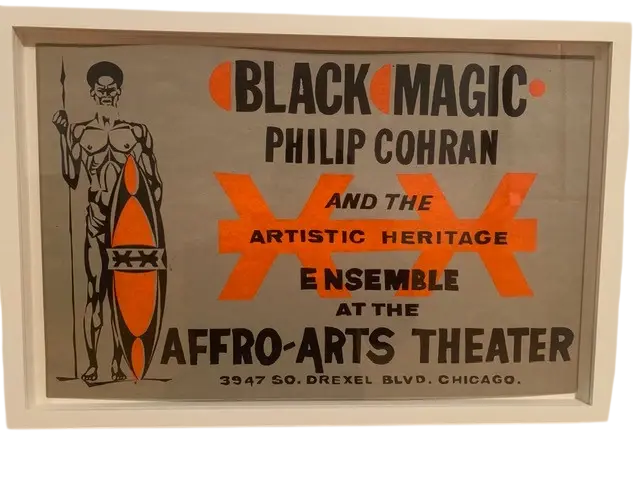
1967 - 1970s | Affro Arts Theater Era
Founded by Cohran in 1967 at 3947 S. Drexel in Bronzeville neighborhood, the Affro-Arts Theater served as a vital gathering hub for Black Arts Movement artists and AACM members. Programs and Performances connected him with artists such as Muhal Richard Abrams, Haki Madhubuti, Carolyn Rodgers, Useni Eugene Perkins, and Gwendolyn Brooks. in 1967, Gwendolyn Brooks mentions Phil Cohran by name in her poem The Wall (1967).


1973 | Transitions East Era
Cohran was a community fixture for years, bringing people together through weekly family-friendly entertainment and programs. Alongside these events, he shared his signature creation: a beloved, proprietary Cohran family recipe that grew into a must-have vegetarian staple.
1980s | Political Footprint
Cohran twice co-chaired Artists for Harold Washington. Under his leadership, the group rallied Chicago’s musicians and artists behind the city’s first African American mayor, successfully raising $1 million.
1980s - 2000s | Educational Ensembles
Cohran taught and mentored young musicians through the Center for Inner City Studies, South Side YMCA, community youth ensembles, brass training groups, and family ensembles.
1980s | Sun Ark Era
Cohran deeply impacted the community from his 75th and Cottage Grove location, hosting rehearsals, public performances, and free music lessons. This dynamic programming ultimately led to the formation of his band, Circle of Sound. Furthermore, he guided and mentored the Mdawakantuan midwifery group.
1990s Onward | Family & Legacy Ensembles
1994 | International Footprint
African Skies, this was a major work by Kelan Phil Cohran that was recorded for the Adler Planetarium in Chicago in 1993 and reflects his lifelong intersts in astronomy, African Civilizations, spirituality, cosmology, and music.
Kelan Phil Cohran’s in depth knowledge of music and lifelong study of ancient cultures, resulted in him being honored with an invitation to be the keynote speaker at the Conservatory of Traditional Music in Beijing, China in 1994, where he presented a body of facts, proving that Chinese people are of African descent. From that thought-provoking lecture, Cohran was invited to extend his stay in China, but he returned to America, continuing his purpose of empowering the African American community. While in China, an Imam (priest) from the Chinese mosque honored Phil with the name of “Kelan,” which he added to his name upon his return to America.
Hypnotic Brass Ensemble
Hypnotic Brass Ensemble, the internationally acclaimed ensemble consisted largely of Cohran's sons: LT, Taras, Hudah, Kris, Yoshi, Shoji, Jehu, Jalom, and Clef, along with drummer and percussion personnel who varied by era. Cohran recorded and performed with them on the album Kelan Philip Cohran & The Hypnotic Brass Ensemble (2012).

African Skies | Adler Planetarium
African Skies is one of the few officially released recordings from Cohran's later career and is often described as a cosmic, spiritual, and educational musical journey. The compositions draw upon his research into celestial phenomena, ancestral knowledge, African cultures, and humanity's relationship to the universe.
The work was performed by Kelan Phil Cohran & Legacy, featuring:
Kelan Phil Cohran - trumpet, Frankiphone (Space Harp), kalimba, harp, percussion, flute, and vocals
Malik Cohran (son)
Oscar Brown III
Aquilla Sadalla
Josefe Marie Verna
Connection to the Adler Planetarium
The recording was commissioned or produced for the Adler Planetarium and was intended to complement themes relating to astronomy and humanity's connection to the cosmos. The original program materials from the planetarium were significant enough that they were included decades later in the 2025 vinyl reissue of the project.
The album reflects Cohran's broader philosophy that music, astronomy, mathematics, history, and spirituality are interconnected disciplines. Throughout his life, he often lectured on celestial studies, "sphereology," and the relationship between African knowledge systems and the cosmos. African Skies is perhaps the clearest musical expression of those ideas.
The following track titles within this composition are inspired by African geography and culture.
Theme
White Nile
Cohran Blues
The Dogon
Sahara
Kalahari
Kilimanjaro
Blue Nile (bonus track on some releases)
Acclaimed Musicians/Artists Directly Associated with Kelan Phil Cohran
Sun Ra
John Gilmore
Marshall Allen
Pat Patrick
Ronnie Boykins
Jay McShann
Charlie Parker
Walter Brown
Big Mama Thornton
Clarence Gatemouth Brown
Jimmy Bell
Walter Perkins
Pete Cosey
Louis Satterfield
Maurice White
Verdeen White
Donald Myrick
Aaron Dodd
Bob Crowder
Charles Handy
Charles James Williams
Gene Easton
Master Henry Gibson
Amina Claudine Myers
Larry King
Steven Galloway
Ajramu
Willie Woods
Ella Pearl Jackson
Oscar Brown, Jr.
Patricia Ann Smith
Chaka Khan
Donny Hathaway
Darlene Blackburn
Maia
Alyo Tolbert
Dick Gregory
Harry Belafonte
Max Roach
Abbey Lincoln
Curtis Mayfield
Amiri Baraka